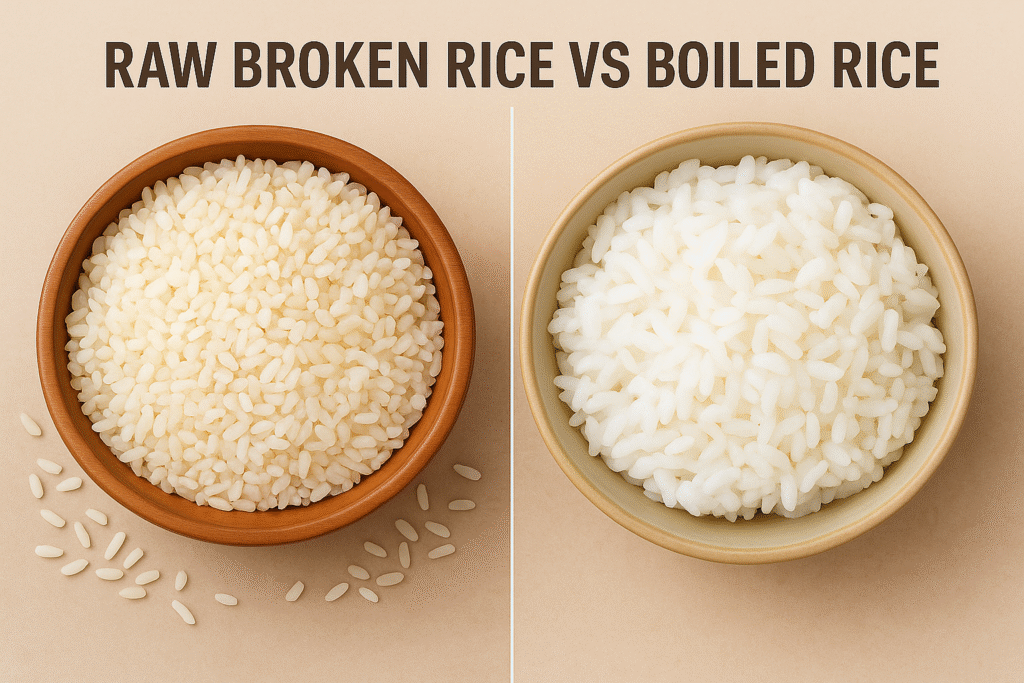
Rice belongs to the staple food of more than a half of the entire population of the world, and India is one of the biggest producers and exporters of the different types of rice. Among the numerous kinds of varieties existing in the global market, two categories of rice include the raw broken rice and the boiled rice, which are used with various purposes globally. The Difference Between Raw Broken Rice and Boiled Rice is very important to the importers, food manufactures and consumers who wish to make an informed decision, depending on their particular needs.
What is Raw Broken Rice?
Raw broken rice is rice grains which have been fractured or broken during milling. These fragments are detached and sold as a different segment of whole grains. The word raw denotes that these grains have not been subjected to any form of parboiling or pre-cooking before being milled.
Key Characteristics:
- Seems white and transparent.
- Is broken into smaller grain fragments between 25 per cent and 100 per cent.
- Takes shorter time to cook because it is small.
- Less expensive than whole grain rice.
knowing Boiled Rice (Parboiled Rice)
Parboiled rice, which is also referred to as boiled rice, is first subjected to a certain amount of steam-pressure and then milled. The paddy is placed in water, pressure steamed and dried and then hull is removed. This partially cooks the rice though still in its husk and has its unique characteristics. The Difference Between Raw Broken Rice and Boiled Rice can be seen in how they are processed and the kind of properties that they are.
Key Characteristics:
- Has got a yellowish or golden color.
- Harder consistency than un cooked rice.
- Is more nutritious because it has been parboiled.
- Slow in cooking compared to uncooked rice.
Processing Methods A Critical Difference.
Raw Broken Rice Processing
The raw broken rice is produced by a simple procedure of milling:
- Harvesting: Paddy is derived out of fields.
- Drying: The moisture is dried out of the grain to optimum levels.
- Hulling: remover of outer husk is carried out by machine.
- Milling: To make white rice, brown rice is polished.
- Sorting: whole grains are sorted out of broken ones.
In this mechanical treatment, a percentage of about 15-20 of grains is broken by different factors such as moisture content in grain, difference between raw broken rice and boiled rice pressure in milling and grain quality.
Boiled Rice Processing
A more complicated treatment is performed on boiled rice:
- Soaking: Paddy is soaked in water several hours.
- Steaming: Under steam pressure, paddy is soaked.
- Drying: Dried paddy: Steamed paddy is dried.
- Milling: Grains are then hardened then finally milled.
- Polishing: Final polishing is the manufacture of the finished product.
Processing of the raw broken rice to boiled rice will have a direct effect on the nutritional value of the food, its texture and its use in cooking.
Food Texture and Cooking Properties.
Raw broken rice cooks quicker and it is softer with a sticky texture. The finer grain size enables water to permeate fast, and it is therefore suitable in foods which need a creamy texture in them. difference between raw broken rice and boiled rice It receives flavors easily and is prone to clumping on being cooked.
Rice that has been cooked in boiling water continues to be separate and firm even when cooked. Gelatinization of the starch in the parboiling process forms a non-sticky texture that is desirable in dishes such as the biryani, fried rice and pilaf. In each grain there is a distinctness and fluffiness.
The Science of Nutritional Differences.
Among the greatest differences between raw broken rice and boiled rice, there is the nutritional content:
Raw Broken Rice Nutrition:
- Reduced levels of retention of vitamins and minerals.
- Majority of the B vitamins and minerals are lost during polishing.
- Mainly contains carbohydrates and calories.
- The glucose index also is more likely to be increased.
Boiled Rice Nutrition:
- Essential fatty acid levels are normal (80% retention of thiamine (Vitamin B1)).
- Increased retention of riboflavin, minerals and niacin.
- Bran contains nutrients, which are transported into the endosperm during steaming.
- Reduced index of glycemia than raw rice.
- Higher fiber content
The process of parboiling takes the nutrients contained in the outer layers into the core of the grain, which makes the rice that has undergone boiling to be nutritionally better even though the two types are polished.
Demand on Exports and World Market.
India controls the international market of exporting rice and both the raw broken rice and boiled rice are involved in the trade. The Difference Between Raw Broken Rice and Boiled Rice, which leads to different market segments, which have different demands.
Demand of Raw Broken Rice Export:
- Primary markets: West African countries, Middle East, Southeast Asia.
- Applied in the food processing industries.
- Famous with animal feed production.
- Economic alternative to cost-beneficial markets.
- Brewing and distilling industries are in high demand
Boiled Rice Export Demand:
- Key importers: European markets, Mid Eastern countries, African countries.
- Make a good choice in terms of long shelf life during shipping.
- Popular in hot climatic countries.
- Hardly prone to pest attacks.
- Appreciated due to the quality of cooking.
The competitive advantage of India is based on the variety of agro-climatic regions, milling facilities, government assistance on exporting goods and the systems of quality control.
Real Life Uses and Applications.
It is important to know the difference between raw broken rice and boiled rice in order to know their best applications:
The uses of Raw Broken Rice have been as follows:
- Food Manufacturing: It is used in the production of rice flour, noodles, as well as breakfast cereals.
- Brewing Industry: This is a primary component of beer production.
- Animal Feed: Poultry and livestock feed that is cost effective.
- Household Cooking: This is best suited to porridge, puddings and fermented food.
- Snack Manufacturing: Snack base of rice crackers and puffed rice.
Boiled Rice Applications:
Restaurant Trade: Biryani, pulao, and fried rice are preferred.
Institutional Catering: School, hospital and Military bulk cooking.
Retail Consumers: Household cooking: Independent grains are wanted.
Food Service: Commercial kitchens that require a steady performance.
Export Markets: Shipping that will cover long distances that need to be strong.
Storage and Shelf Life
This varicula difference between raw broken rice and boiled rice also relates to the storage features. Uncooked broken rice is more vulnerable to the uptake of moisture, insect infestation, and rancidity in the absence of the proper form of storage. Under optimal conditions, its shelf life is normally 6-12 months.
The hard grain structure of boiled rice is as a result of the processing process; it is resistant to moisture and pests. It is able to last up to 18-24 months without dramatically impairing quality hence serves well in areas with minimal storage capacity or the longer supply lines.
The Export of rice is highest in India.
- This fact of India being a large exporter of difference between raw broken rice and boiled rice has been backed by the following factors:
- Agricultural Strength; India produces rice over 44 million hectares that are of different varieties capable of different processing.
- Processing Infrastructure: There are thousands of modern rice mills with high level sorting and grading in the country.
- Cost Competitiveness: The advantage is lower costs of production and lower costs of labor that allow the company to compete in the international market through lower prices.
- Government Policies: The export incentives, quality certifications and trade agreements enable ease in international trade.
- Quality Assurance: A high level of conformity to international standards of quality and food safety creates confidence with the importers.
Conclusion
The difference between raw broken rice and boiled rice covers the modes of processing, nutritional value, texture, cooking characteristics and usages in the market. Raw broken rice is cheap and can be used in various ways by the processing industries, whereas boiled rice is more nutritious, has a longer shelf life, and cooking qualities that are more desired by the direct consumers.
The two types are major contributors to food security in the world and Indian skills in the production and export of these types of rice has remained to satisfy the various requirements of the world. Be it a food producer who wants to buy cheap foodstuffs or a consumer who wants to cook the more nutritious food, knowing these distinctions will allow them to make better decisions when choosing and purchasing rice.